Global Citizenship Education in national curricula.
This webinar, co-developed with the Global Education Time (GET) project, is the third in the new ANGEL Research to Policy Webinar Series


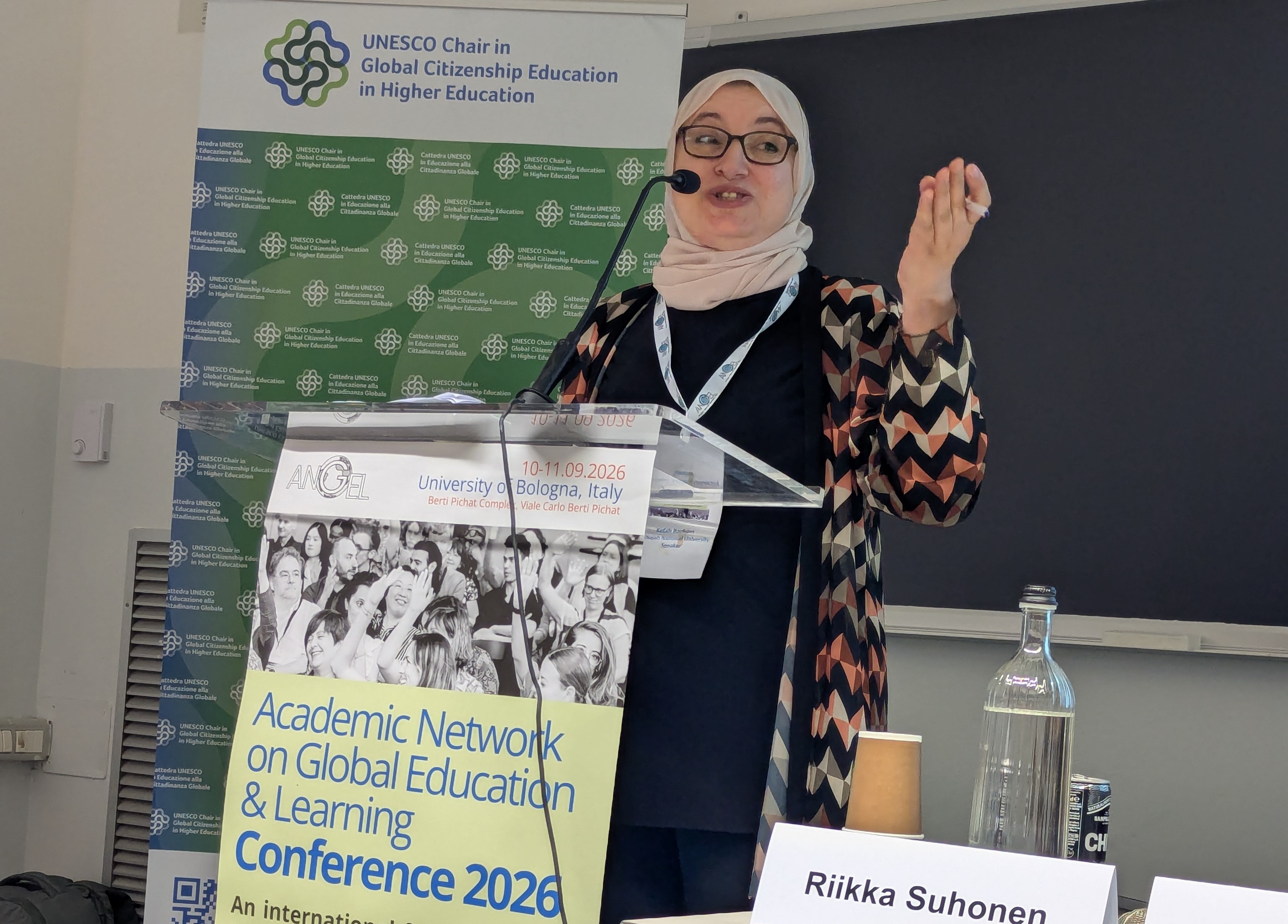
A guest blog by Dr Kefah A. Barham (An-Najah National University, Palestine), following her contribution to the plenary sessions of the ANGEL Conference 2026, 10/11 September.
Photo by Alessia Raucci
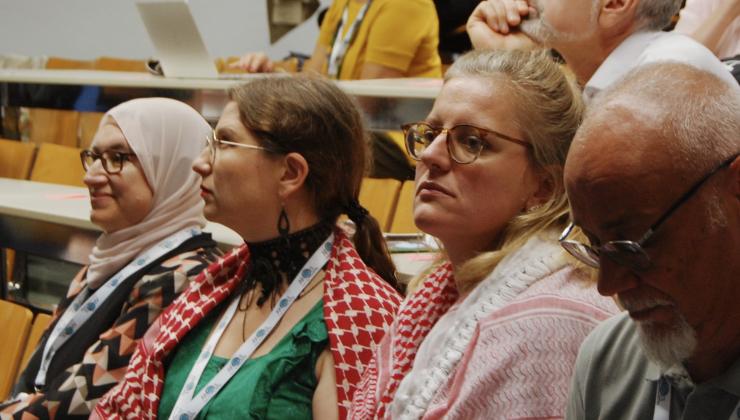
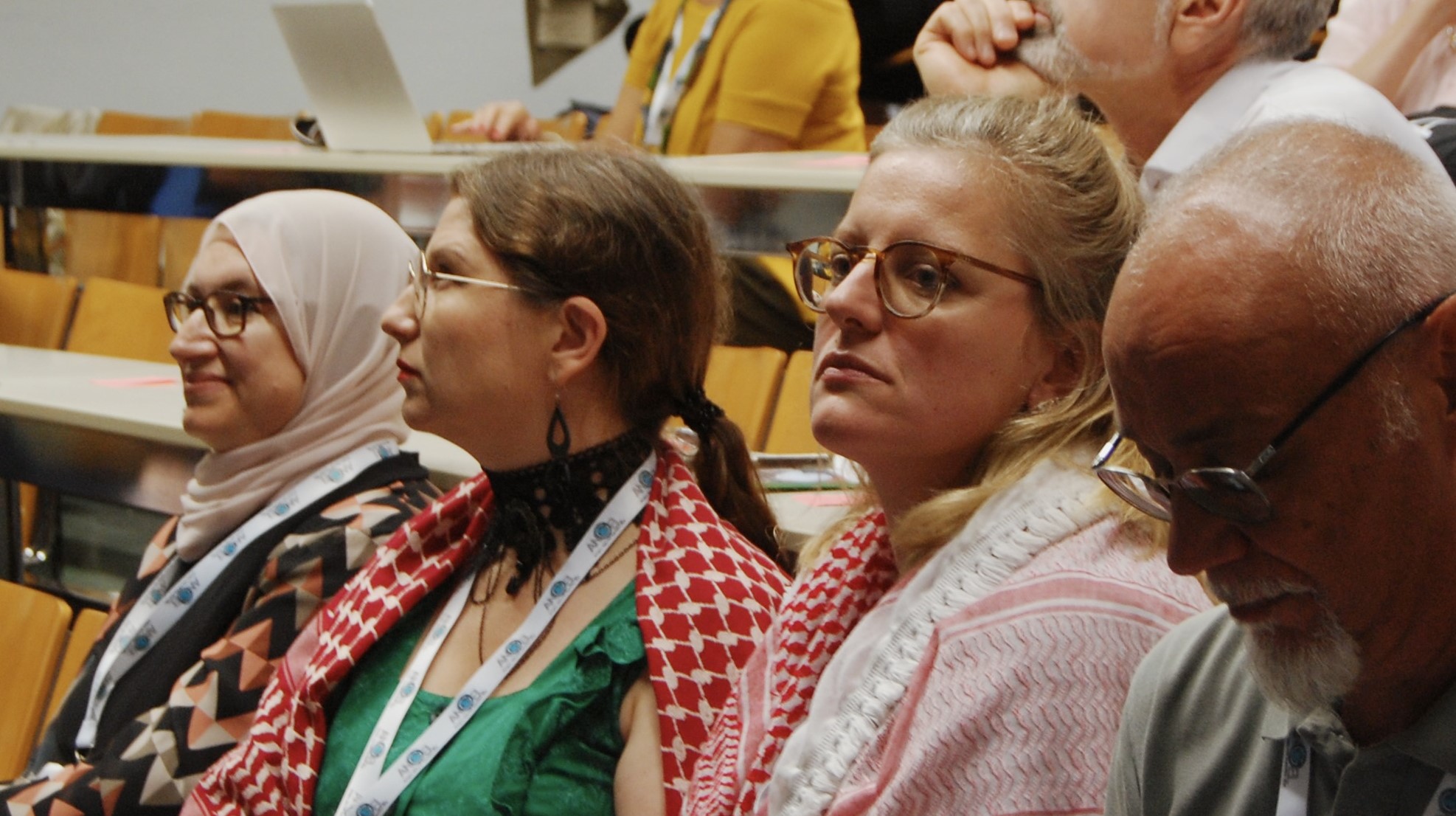
As I reflect on the ANGEL Conference in Bologna, I find myself returning not only to what we discussed, but also to what it meant to be there.
Coming from Palestine and the occupied West Bank, participating in an international conference is never simply a matter of booking a flight and arriving at a venue. Movement and travel carry uncertainty, and that uncertainty is itself part of the educational reality that I research, teach and live. For this reason, finally arriving in Bologna—and being received with such warmth, care and genuine appreciation—meant more to me than ordinary conference participation.
I am deeply grateful to the ANGEL community, GENE, the conference organisers, and everyone who worked behind the scenes to make my participation possible. The practical support was essential, but what has stayed with me just as strongly is the human dimension of that support: the conversations, the encouragement, the willingness to listen, and the expressions of solidarity that I encountered throughout the conference. The conversations during and after the plenary reminded me of something that can easily become difficult to hold onto: we are not alone.
During the plenary session, What Palestine Teaches Global Citizenship Education: Palestinian Voices, Sumūd, and Action, I spoke from my research, teaching and lived experience in the occupied West Bank. My contribution asked what Global Citizenship Education means when values such as human rights, dignity, justice and freedom of movement are taught as universal principles but are experienced by students as unequal or denied in everyday life. I used examples from Palestinian education to explore the gap between the ideals of GCE and the realities through which students encounter them, particularly in relation to mobility, ethical responsibility, identity and participation. My central argument was that Palestine should not be approached only as a context of suffering or as a case to which existing theories are applied. Palestinian experience also produces educational knowledge. It can challenge GCE to think more seriously about power, agency, justice and what solidarity requires in practice.
One of the concepts through which I explored these questions was Sumūd.
Sumūd, an Arabic word commonly translated as steadfastness, is deeply rooted in Palestinian history and experience. It is often understood as the capacity to remain, persist and sustain life in the face of occupation, dispossession and continuing uncertainty. But for me, Sumūd means more than endurance or resilience. It is also about preserving dignity, rootedness, identity and relationships; exercising agency; caring for others; resisting erasure; and continuing to imagine and work towards a future even when the conditions for doing so are severely constrained.
In education, this raises an important question: does Sumūd simply mean that Palestinian students and educators continue despite everything, or can educational institutions and communities help create the conditions that make meaningful participation, agency and hope possible?
The experience of Bologna led me to think about Sumūd in a new way.
The support that enabled me to participate in Bologna offered a small but meaningful example. The larger political and structural conditions affecting Palestinian mobility did not disappear. But people and institutions acted within their own spheres of influence to make participation possible. That distinction matters.
It has led me to think increasingly about the difference between Sumūd that is enabled and steadfastness that is demanded.
When institutions listen, create access, share resources, provide flexibility and remove barriers within their control, they do not eliminate the structural injustice. But they redistribute some of its burden. They help create conditions in which people can exercise agency rather than simply being expected to endure.
Perhaps this is one of the most important lessons I am taking home from ANGEL: solidarity becomes meaningful when it moves from sympathy to relationship, from listening to responsibility, and from statements to practice.
This does not mean that every educator or academic institution can resolve the structural conditions Palestinians face. Clearly, they cannot. But each of us occupies a sphere of influence. Within that sphere, there are decisions about access, representation, curriculum, knowledge, resources, partnerships and participation.
The question, then, is not only, “Do we stand in solidarity?” but also: “What does our solidarity change within the practices for which we are responsible?”
I returned from Bologna with gratitude, but also with a renewed sense of responsibility. The conference strengthened my conviction that Global Citizenship Education must remain a space where difficult realities can be named rather than avoided; where voices from contexts of injustice are not merely included as testimony but recognised as sources of knowledge; and where commitments to human rights and global solidarity are tested by what we are prepared to do in practice.
I returned to Palestine carrying something important with me: the reassurance that across borders and institutions there are people who continue to believe that justice, dignity and human rights are universal precisely because they must apply to everyone.
Perhaps that, too, is a form of solidarity.
And perhaps solidarity, when it shares rather than merely observes the burden, can itself become a source of Sumūd.
Kefah Barham is an Associate Professor in the Faculty of Educational Sciences and Teacher Training at An-Najah National University in Nablus, Palestine. Her academic work focuses on teacher education, pedagogy, qualitative research, citizenship education, and education in contexts shaped by conflict, occupation, and social change. Visit her LinkedIn profile
We are looking for ideas from the ANGEL community for events during the 2025/26 academic year.
Carousel image attribution: "panoramio (2525)" by William “Patrick” Ma. Under CC 3.0
The establishment of this network and website has been made possible with funding support from the European Commission.
The activities and publications of the network are the responsibilities of the organisers, the Development Education Research Centre, and can in no way be seen as reflecting the views of the European Commission.