Global Citizenship Education in national curricula.
This webinar, co-developed with the Global Education Time (GET) project, is the third in the new ANGEL Research to Policy Webinar Series

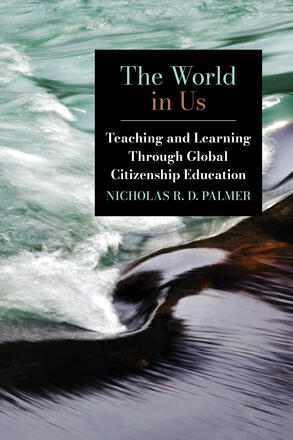
ANGEL member Nicholas Palmer (University of Melbourne) has published a new book with SUNY Press, titled The World in Us: Teaching and Learning Through Global Citizenship Education.
The book reimagines global citizenship education by taking a relational approach, offering educators and scholars new frameworks to navigate complexity and foster meaningful learning experiences.
In an era of increasing polarization and complexity, The World in Us challenges conventional approaches to global citizenship education by offering a generative, critical framework for teaching and learning. Nicholas R. D. Palmer argues that true global engagement must move toward constructive, relational, and transformative action. Drawing on a diverse range of perspectives—including Australian Indigenous thought, the philosophy of Simone Weil, and Palmer's own teaching experience—the book introduces a host of empirically grounded concepts to rethink how we navigate global interconnection. With a balance of theory and practice, Palmer provides educators with practical tools to foster meaningful, inclusive, and contextually grounded global learning experiences. The World in Us is essential reading for scholars, educators, and policymakers seeking to bridge divisions in the field, the classroom, and the wider world.
Nicholas R. D. Palmer is an Australian lecturer and researcher whose work explores the intersections of global citizenship education, relational ethics, and the philosophy of education. He lectures at the University of Melbourne, Australian Catholic University, and Federation University, and has extensive international experience as an IB educator and academic mentor. His forthcoming monograph, The World in Us: Teaching and Learning Through Global Citizenship Education (SUNY Press, 2026), reimagines global citizenship through dialogic, postcritical, and relational frameworks. Palmer’s scholarship engages thinkers such as Habermas, Papastephanou, and Forst, advancing critical and plural approaches to education in an age of global complexity and technological transformation.
We are looking for ideas from the ANGEL community for events during the 2025/26 academic year.
Carousel image attribution: "panoramio (2525)" by William “Patrick” Ma. Under CC 3.0
The establishment of this network and website has been made possible with funding support from the European Commission.
The activities and publications of the network are the responsibilities of the organisers, the Development Education Research Centre, and can in no way be seen as reflecting the views of the European Commission.