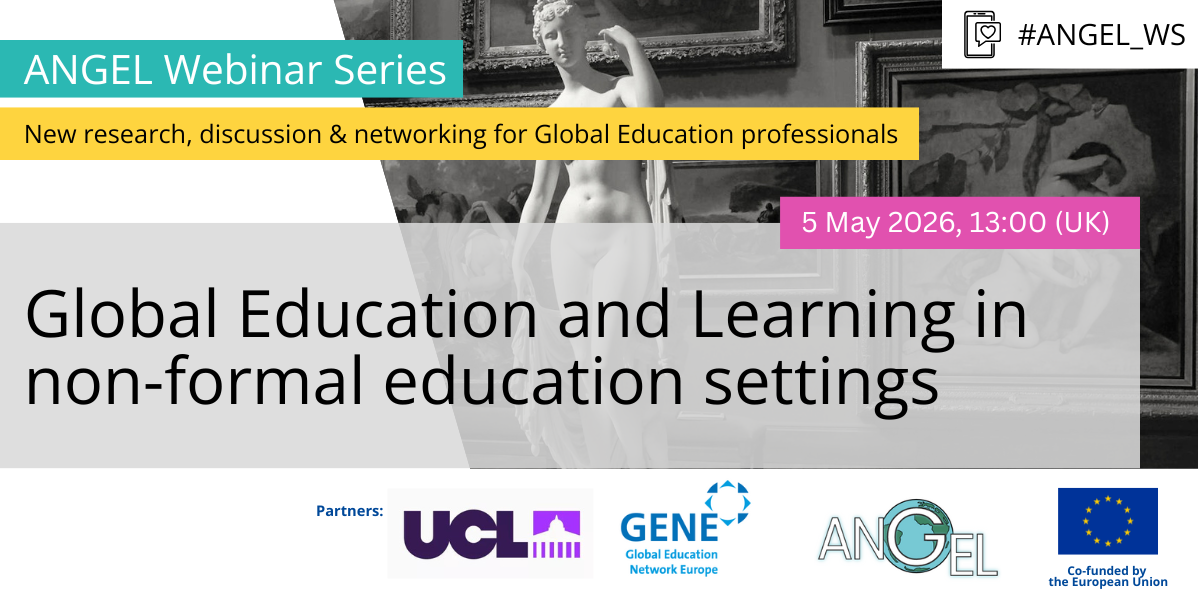
Global Education and Learning in non-formal education settings
Summary
The place of non-formal education maintains an important role in global education and learning (GEL). Although considered an established field, its diversity presents challenges to the perceived consistency of GEL. This seminar brings together research to explore a dialogue across three different non-formal educational settings that value lived experiences and interdisciplinarity to engage critically and meaningfully with local and global heritage, culture, ecosystems and peace.
Presentations
Embodied peace education: praxis, museums and informal teacher education.
Alexis Stones, UCL Institute of Education
UNESCO’s call for an approach to peace education as a “participatory, and dynamic process that nurtures our ability to value human dignity and take care of ourselves, each other, and the planet we share” (2024) demands an education that unites those from diverse worldviews and experiences by providing ways to imagine and transform through building empathy rather than problem solving. Museums and galleries have an important role to play here in developing critical harmony that values difference and strives for balance (not coherence) among diverse perspectives (Ho and Barton, 2020) to amplify underrepresented educators’ voices for democratic public places of learning. Building on practice-based research in teacher education with pre-service teachers in England to promote peace and decolonial approaches to artworks in museums and galleries, this presentation connects peace studies, trauma-informed approaches, museum education and drama as emancipatory practice. Boal’s (1974) participatory methods are explored as forms of conscientization and interventions on colonial and hegemonic narratives in museums as public spaces of informal learning. Grounded in praxis and lived experiences, this work explores the potential of critical pedagogy for student teachers’ development as global educators and decolonial practitioners through reflexivity and embodied dialogue. Praxis in informal education settings is explored as a bridging metaphor for teachers’ inclusive and critical engagement with a formal curriculum.
Art and Nature - a combination for the future
Andreas Pregler, Artist and Youth Worker, Cham, Germany.
Andreas Pregler bridges the gap between artistic research and concrete implementation in extracurricular cultural work with children and young people. The research space is a forest in a border mountain range between Germany and Czechia with its past and its current situation, which is marked by climate change and its effects. The concept of the workshop series developed by Andreas Pregler is entitled “Forest Art.” Here, artistic work leads to embodied knowledge. This forms the basis for future developments.
Global Education through artistic handicraft production: Exploring potentials for situated inquiry on informal global education in Uganda
Anna-Lisa Klages, Technische Hochschule Ingolstadt
In the context of empowerment initiatives in Uganda, artistic handicraft production is promoted as a method for sustainable development (Klages, forthcoming). The suitability of artistic handicraft production is attributed to its vocational nature, gender sensitivity and the capacity for project beneficiaries to become entrepreneurs (ibid). Moreover, the artefacts are regarded as culturally appropriate due to their frequent association with local cultural heritage and history.The artefacts manifest multiple cultural interpretations, whether as souvenir art, functional household objects with particular aesthetic features, or as cultural artefacts with symbolic significance (Hume, 2013; Errington, 1998). As such, they become sites of cultural negotiation and - inadvertently - of informal global education, since the production processes of artistic handicrafts involve moments of self- and cultural reflection, thereby leading to the creation, reproduction and deconstruction of images of the self and the world.In this presentation, I will explore some implications of artistic handicraft production as sites of informal education for critical research and global education. I will build on findings from my PhD research, in which I reconstructed the situatedness of artistic handicraft production in contemporary Ugandan civil society.
Audience
Researchers and educators.
Format
This event, to be held at 13:00 (UK) on the 5th May 2026, will last around 90 minutes and will be hosted via Zoom. The event will be in English. Please register via Zoom using the button on this page. The event will be Chaired by Elina Lehtomäki, Co-Chair of the ANGEL advisory board.
Session leaders
- Anna-Lisa Klages is a research associate at the Research and Transfer Center for Sustainability Studies of the Technical University of Applied Sciences Ingolstadt (THI) and the institutional coordinator of the European Universities Alliance ACE²-EU at THI in Germany. I hold degrees in Social Work and Art Therapy, my PhD is in Interdisciplinary Humanities. I have international working experience in the areas of community development, art therapy, and adult education both within and outside of academia. My research interests include the linkages between cultural heritage and community development, international cooperation, just sustainability transition, human-more-than-human relations, informal cultural education, and methodology development esp. Situational Analysis according to Adele Clarke.
- Alexis Stones is subject lead for the Religious Education PGCE at the UCL Institute of Education where shge has taught since 2015 and led the course since 2020. She has worked in education for more than 30 years, as an RE teacher, lecturer and tutor for the RE PGCE, theatre practitioner, and museum educator since 2010.
-
Andreas Pregler works as a visual artist in the field of contemporary art and as a certified social pedagogue in the field of extracurricular cultural education for children and young people at the Office for Youth and Family in the district of Cham, Germany. He holds a Master of Fine Arts degree and a diploma in social pedagogy.
The ANGEL Webinar Series
This event is part of a series of online events run by the Academic Network for Global Education & Learning. The series is aimed at Global Education professionals, as well as anyone with an interest in research in the fields of Development Education, Global Citizenship Education, Human Rights Education, Education for Sustainable Development, Education for Peace, and Intercultural Education. This event, along with the other activities of the ANGEL network, is co-funded by the European Union.**
** The establishment of this network and website has been made possible with funding support from the European Commission. The activities and publications of the network are the responsibilities of the organisers, the Development Education Research Centre, and can in no way be seen as reflecting the views of the European Commission.